

Participating in competitive offshore events like the Round Ireland Yacht Race or the Dun Laoghaire to Dingle race is the pinnacle of domestic competitive sailing. However, taking a high-performance vessel out into the open Atlantic or the unpredictable Irish Sea exposes your crew and your asset to risks that a standard marine policy simply won't cover.
Securing comprehensive racing yacht insurance in Ireland requires a clear understanding of the unique demands of bluewater racing. Here is an in-depth breakdown of what your offshore race yacht cover must include to keep you protected on the racecourse.
A standard cruising insurance policy usually explicitly excludes racing, or limits coverage to local club regattas during the summer months. When you transition to true offshore racing, you need a dedicated racing vessel policy that acknowledges the extreme physical demands placed on your hull, spars, and sails.
Unlike in-shore racing, offshore events happen in deep water, often overnight, and frequently in severe weather conditions where assistance may be hours away. A robust policy must protect against structural damage caused by slamming into heavy seas, accidental groundings on remote coastlines, and collisions at night when crew fatigue sets in. When setting up your coverage, ensure the territorial limits explicitly encompass the exact coordinates of your intended racing routes.
When reviewing your competitive sailing insurance, standard "off-the-shelf" marine coverage won't cut it. Your policy document should explicitly feature several specialized clauses designed specifically for high-stress racing environments.
This is the most critical component of any racing yacht insurance in Ireland. In tight start-line sequences or crowded mark roundings at night, the risk of collision is incredibly high. Most international offshore race organizers require a minimum third-party liability limit of €3 million to €5 million. Your policy must provide this level of cover specifically while racing, protecting you against catastrophic financial claims if your yacht damages another vessel or causes personal injury to a third party.
In competitive racing, rigs are pushed to their absolute limits. If a shroud snaps or a spinnaker pole fails under a heavy kite load, a dismasting can happen in seconds. Standard policies frequently exclude mast, spars, and rigging damage while racing, or they apply heavy depreciation percentages based on the age of the rig. Look for an offshore race yacht cover that offers a "new for old" replacement clause or a fair, fixed depreciation scale for racing rigs.
Sails are the engine room of a racing yacht, and they are highly susceptible to damage. From a blown-out spinnaker during a heavy-air downwind leg to a torn mainsail during a rapid reefing maneuver, sail damage is the most frequent insurance claim in competitive sailing. Ensure your racing vessel policy explicitly extends to cover your entire sail inventory—including high-modulus racing laminates like carbon fiber or Kevlar—both while stored and while actively in use on the water.
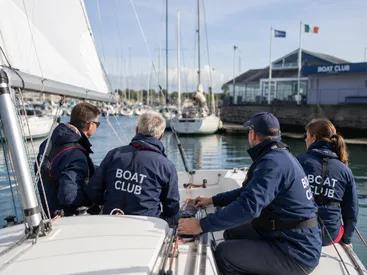
Offshore racing is a team sport, and your crew is your greatest asset. Whether you sail with a core group of seasoned amateurs or a professional crew, your competitive sailing insurance needs to have robust personal accident and liability protection.
Furthermore, underwriters providing racing yacht insurance in Ireland will expect your vessel to strictly adhere to World Sailing Offshore Special Regulations (OSR) Category 1 or 2 safety standards, depending on the race. This includes carrying certified life rafts, EPIRBs, AIS tracking devices, and storm sails.
Because the probability of minor damage is significantly higher in competitive racing than in leisure cruising, insurers manage their risk by altering the policy excess structure.
When you activate your racing extension, the standard policy excess often doubles or triples specifically for incidents that occur during a race. For example, if your standard cruising excess is €500, it might rise to €1,500 or higher during a competitive offshore event. Understanding these thresholds beforehand helps you accurately assess which minor cosmetic damages are worth claiming, and which ones are better handled out of pocket to protect your no-claims bonus.
Investing in the right racing yacht insurance in Ireland isn't just about ticking a box for the race organizers; it is about ensuring that a single tactical mistake or equipment failure doesn't end your sailing career. By securing a comprehensive racing vessel policy that includes high liability limits, specialized rig protection, and robust crew cover, you can focus entirely on your navigation, tactics, and boat speed.
Before you head out past the breakwater for your next major offshore challenge, review your policy closely with a marine specialist to confirm you have the exact offshore race yacht cover your campaign requires.